
Across 15 ISEB-format pretest papers, 541 questions in all, a child is handed a rule and asked to use it exactly twice: once as a string of "think of a number" instructions to be run backwards, and once as a set of made-up symbols. On the two current St Paul's Girls' School sample papers, the same kind of question accounts for 12 of the 51. A child working steadily through the first set as preparation for St Paul's would reach the exam having met the thing it leans on hardest twice.
Neither set is unusual, and the gap between them is not a quirk of one school. Ask on a parenting forum how to prepare for 11+ maths and the answer usually comes back as past papers, which is sound advice until it is taken to mean that one exam's papers are practice for another's. I wanted to know how far that holds, so I went through 65 papers from seven exams that come up in 11+ preparation, 2,364 questions in total, and noted the learning objective behind each one, meaning the particular thing a child has to be able to do, at the grain a teacher would write at the top of a lesson, rather than a topic such as fractions or area.
| Exam | Papers | Which papers |
|---|---|---|
| St Paul's Girls', current samples | 2 | Samples for 2027 entry |
| St Paul's Girls', older papers | 4 | Three-section papers from before the change |
| City of London Girls | 3 | Two older full papers and a Stage 2 paper |
| Latymer Upper | 4 | The two current samples and two older ones |
| CSSE | 8 | Papers for entry in 2015 to 2023 |
| Sevenoaks | 15 | Sample papers dated 2010 to 2024 |
| ISEB-format pretest | 15 | Practice papers in the pretest format |
| Primary Maths Challenge | 14 | A national maths challenge rather than an entrance exam; November papers, 2004 to 2022 |
No two of them lean on the same thing
The simplest comparison is to ask what each exam comes back to most often, and the seven exams give seven different answers.
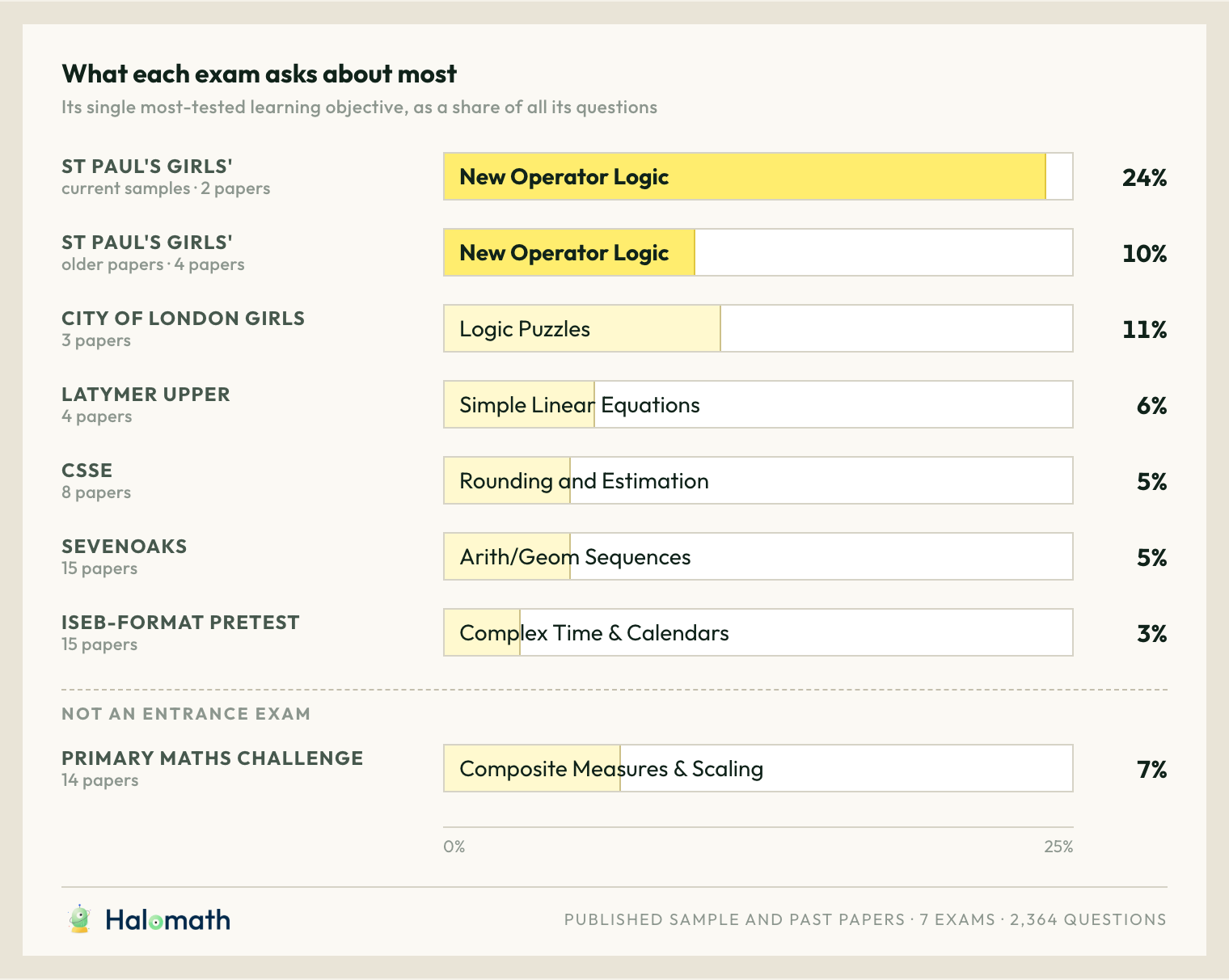
St Paul's appears twice because its paper has changed shape, from three sections to two, and it is the one place where an answer repeats. That is what would be expected if the emphasis belongs to the school rather than to chance, since the format changed and the thing it leans on stayed the same, only more so. New Operator Logic covers questions like those in the opening, where a child is given a rule, as a function machine or a made-up symbol, and has to use it, and on the current papers it accounts for nearly a quarter of everything asked.
Some care is needed with a comparison like this. When an exam spreads itself across a hundred objectives, the one at the top may be only a question or two ahead of the next, and chance alone could shuffle it. So I checked what would happen if the seven were really one exam printed under different names, by pooling all 2,364 questions and dealing them back out in the same numbers, many times over. Seven different answers came up fewer than once in every 40 attempts, so the differences are very unlikely to be an accident.
They overlap a good deal
It would be natural to conclude that the seven exams test different things, and for the most part they do not. Fifteen learning objectives appear on every one of the seven, among them New Operator Logic, the function machines and made-up symbols from the opening, and Simultaneous Equations, which comes up again below. Between them the 15 account for somewhere between a fifth and just under half of each exam's questions, and objectives that appear on at least five of the seven account for between 66% and 83% of each.
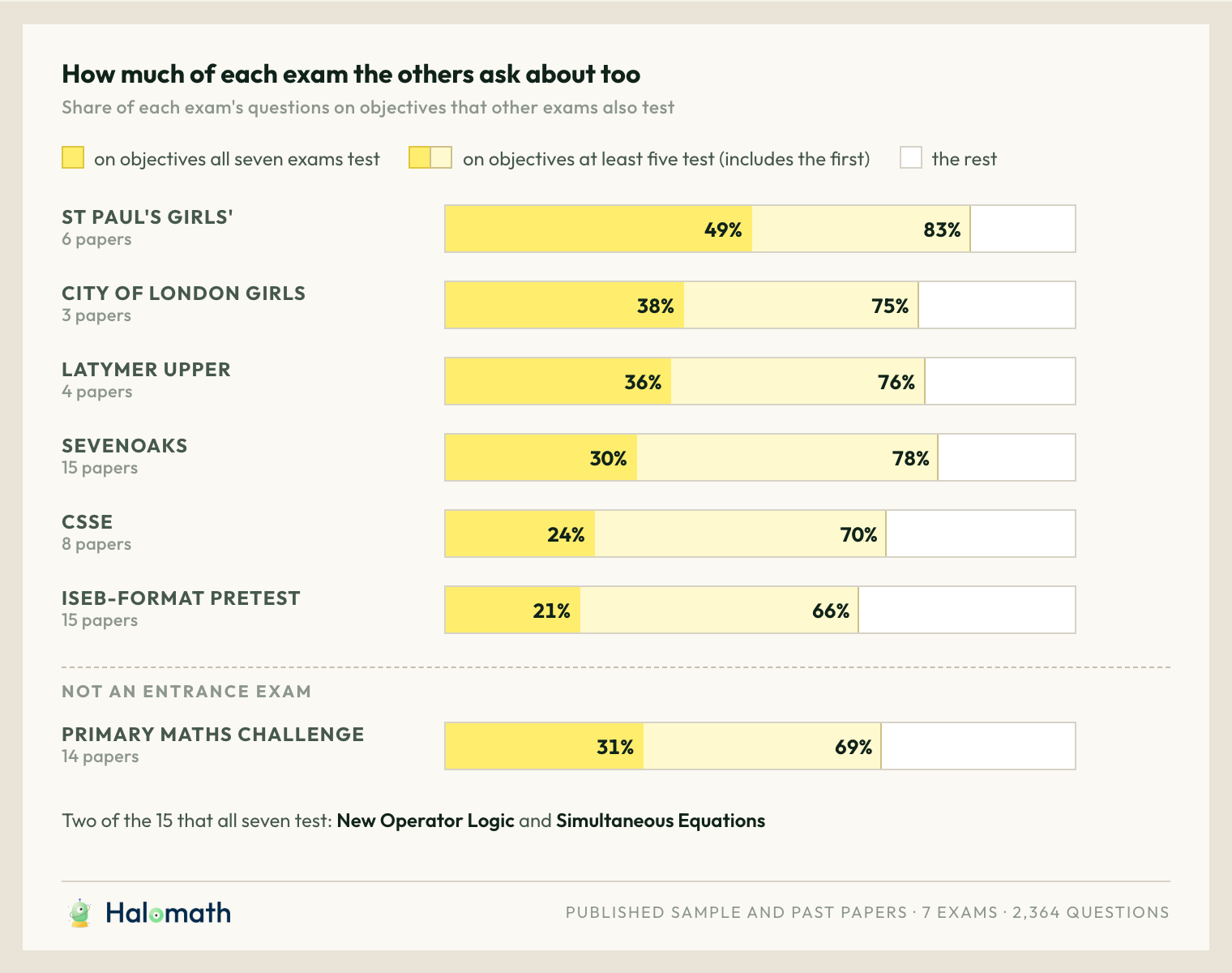
Put the other way round, the objective behind 47 of the 51 questions on the current St Paul's papers turns up somewhere in the 15 Sevenoaks papers, even though the two exams could hardly feel more different to sit. Where a family has a good run of papers to work through, coverage is rarely what is missing, and the differences lie in two places that a list of topics will not show: how much of each objective an exam asks, and what it asks a child to do with it.
The same objective, in very different amounts
Sharing an objective is not the same as giving it the same weight, and New Operator Logic is the clearest case. Across all six St Paul's papers, old and new, it is 30 of 230 questions, and in the ISEB-format pretest it is 2 of 541, so a child practising St Paul's papers meets it 35 times as often as one practising the pretest. That is the largest gap, but it is not an exception: of the 15 objectives all seven exams share, 13 take up at least six times as much of one exam as of another. Logic Puzzles, for instance, are 17 of the 153 questions on the City of London Girls papers and 4 of the 541 on the pretest.
Beyond the shared 15, some of what one exam leans on is missing from another altogether: Rounding and Estimation, the objective the CSSE asks about most, does not appear once in the four Latymer Upper papers, and Arith/Geom Sequences, the one Sevenoaks returns to most often, comes up 24 times in 460 Sevenoaks questions and not once in 356 from the Primary Maths Challenge.
The same objective, asked differently
The amounts are only half of it. The same learning objective can ask a child to do quite different work depending on which exam she meets it in, and this is where the character of each exam shows most clearly.
Simultaneous Equations is one of the 15 that all seven exams share, and of those 15 it is the one whose weight varies least from exam to exam, so whatever separates the exams here, it is not the amount. Three of them show the range. Of the 22 Sevenoaks questions on it, 11 hand the child an equation and ask her to solve it, spread across six papers from 2010 to 2022, so this is the school's habit rather than one question broken into parts. The CSSE's most common form is a problem in words, and the equation is hers to write: she has to decide what to call the unknown amount and turn each sentence into a relationship. The St Paul's form has no numbers in it at all, only a chain of made-up symbols, and the work is to substitute along the chain until one symbol is expressed in terms of another.
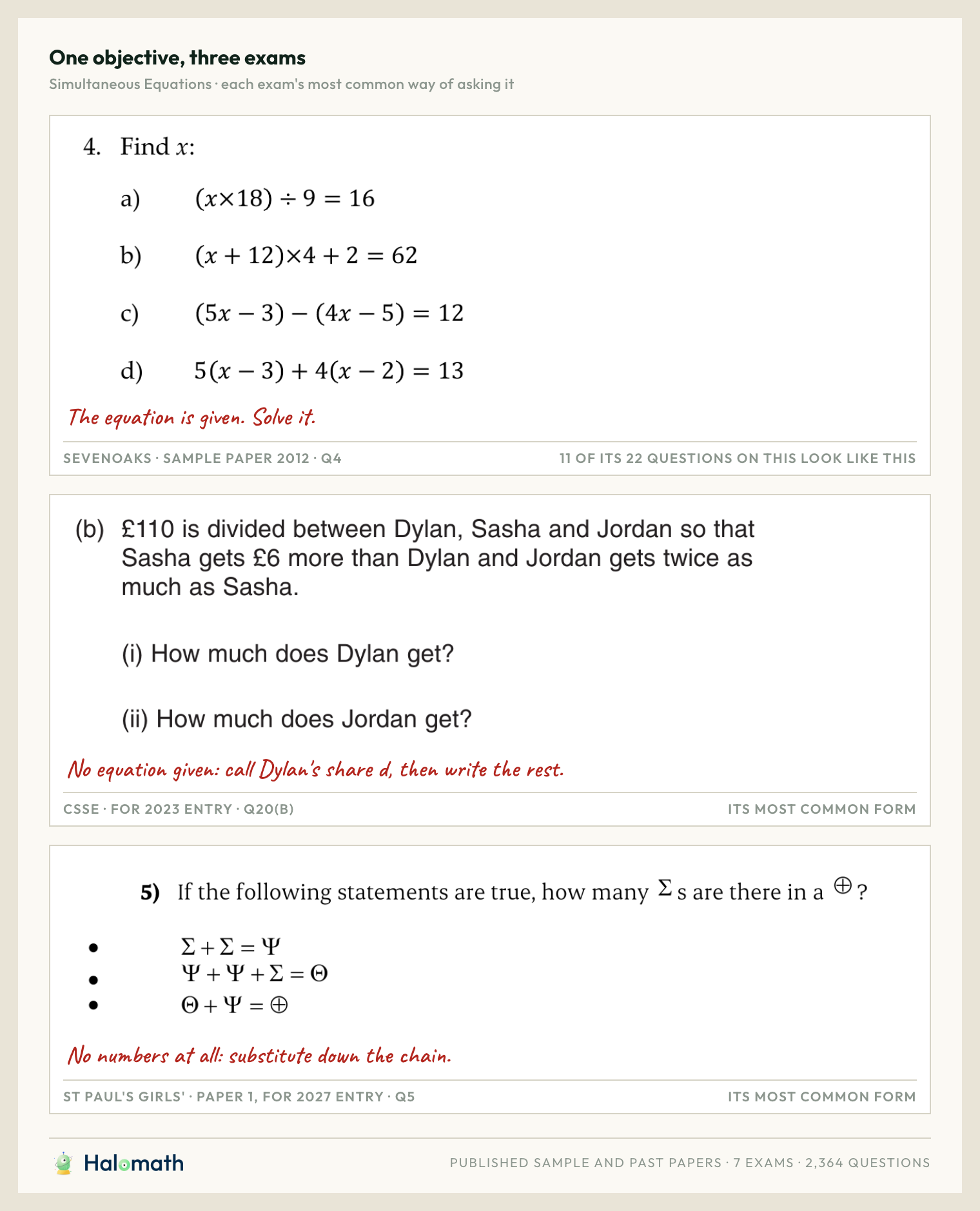
A child who has solved forty equations like the Sevenoaks ones has practised the part that comes after an equation exists. The CSSE question asks for the step before it, writing the equation, and the St Paul's question asks for something closer to a logic puzzle, and none of those forty required either.
This is not peculiar to one objective. Across the 15 shared objectives the exams differ in which forms of question they choose, and when I shuffled which exam each question came from, a difference that large came up about once in a hundred attempts. To keep that check honest, I counted the lettered parts of a single question only once, so that one long question could not inflate it. Whether some exams simply ask the same objective harder is less clear-cut: on some objectives, this one among them, the gap is plain, but across all 15 it is within what chance could produce.
What each exam is like
Put those forms of question together across a whole exam and each one has a recognisable character. The figure below shows, for each exam, what it asks a child to do noticeably more or less often than the other exams do, and it includes only the differences that pass the same kind of chance check as above.
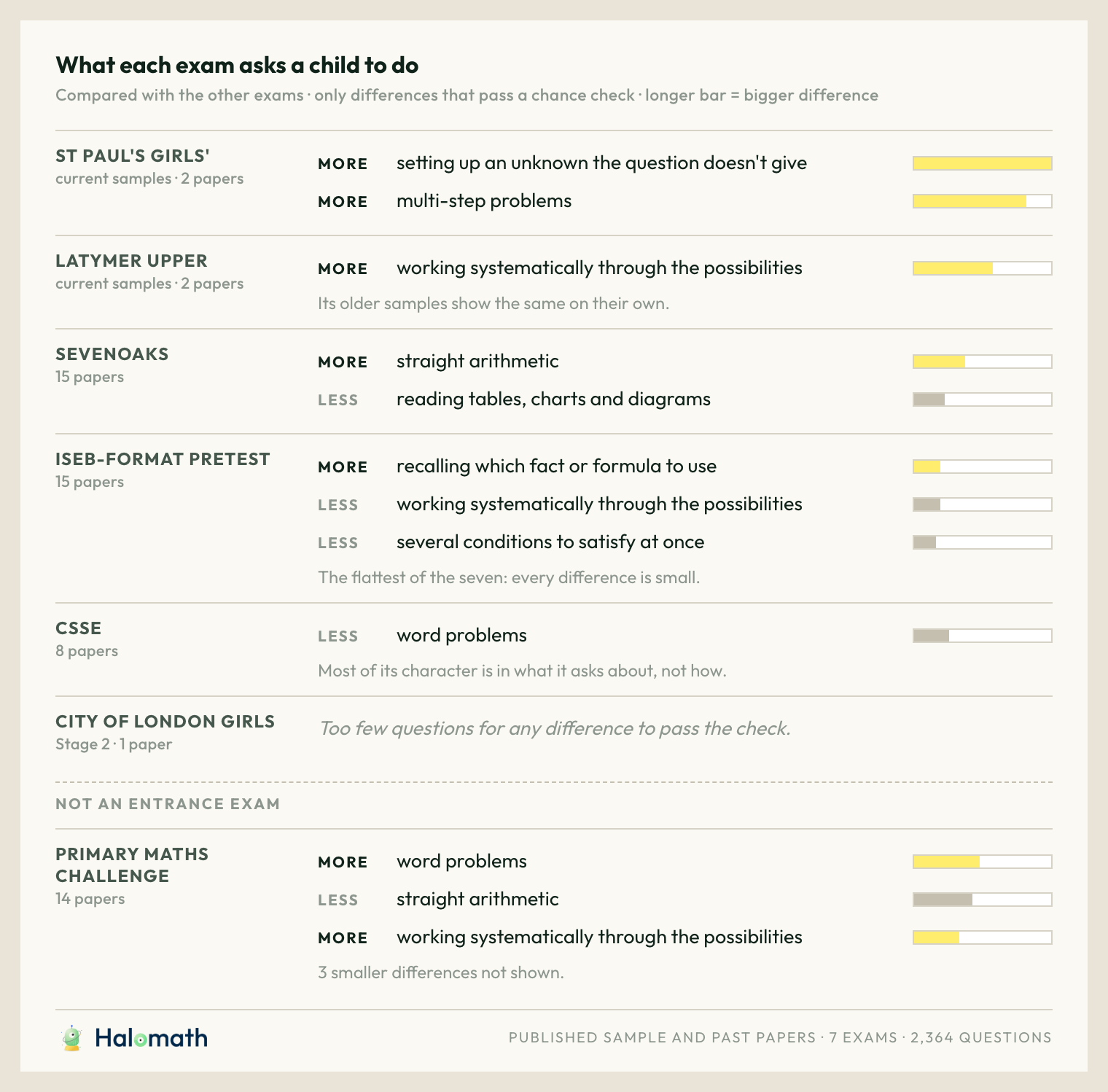
The current St Paul's papers stand furthest from the rest: a child has to set up an unknown the question does not give her, and work through multi-step problems, which is what the earlier piece on those papers found by reading them question by question. Sevenoaks asks for more straight arithmetic than the others and makes less use of tables, charts and diagrams, which fits its habit of handing over equations ready to solve. Latymer Upper asks a child to work systematically through the possibilities, and its current samples and its older ones each show that on their own. The ISEB-format pretest is the flattest of the seven, with every difference small, and the CSSE's character lies mainly in what it asks about rather than how. The City of London Girls Stage 2 paper has too few questions for any difference to pass the check, which says nothing about whether it has a character, only that one paper is not enough to measure it. The Primary Maths Challenge, which is not an entrance exam, leans on word problems and asks for less straight arithmetic than the others.
What this means at home
The papers worth practising are those of the exam she is actually sitting, and everything else is extra. Another exam's papers will cover much of the same ground, but in different proportions and often in a different form, and on the objectives that matter most to a particular school the proportions alone can be out by a factor of ten or more.
The difficulty is that there is not always much of the right material. Some schools publish a good run of papers, Sevenoaks among them, while others publish one or two, and the current St Paul's format exists as a single pair. Older papers from the same school are not always a substitute either, because a school that changes its format may change its proportions with it, and on the St Paul's figures that change was large.
It is also worth being wary of preparation organised by topic. A revision book that gives each topic a chapter gives each one roughly equal room, usually in a single form, and of the seven exams only the pretest comes close to being built that way. Worked through from front to back, a book like that will give a child too little of whatever her exam leans on and spend much of her time on what it barely mentions.
What I cannot tell you
These are published sample and past papers, and a live paper can differ from them. The seven exams are also represented very unevenly, the ISEB-format pretest and Sevenoaks by 15 papers each and the current St Paul's format by two, so the figures for the smaller sets rest on less and would move more with each paper added. The objective and form behind each question are my reading, checked question by question, and they have not been checked against how children actually do on these papers. Everything above is a reading of the papers rather than a measurement.
What I have built
I am building Halomath, a daily maths coach for UK primary children aged 5–11, and all seven of these exams have a mock in it. Each mock follows the structure of a published paper for that exam: each question is built to the same objective as the question that sits in that place, favouring the forms of question that exam actually uses for it, with a lean towards the kind of work that part of the paper asks for, and with different wording and different numbers each time she sits it. Eight papers are in it so far, the seven here and one at 7+. That is not many, and I am adding them one at a time.
I have no affiliation with any of the schools or bodies named here, and nothing here predicts what will be on any future paper.
If there is an exam you would like added to the comparison, tell me which one.