
St Paul's Girls' School publishes two sample maths papers for 11+ entry — Paper 1 and Paper 2, both on the school's 11+ entry page. Each runs for 50 minutes, without a calculator, and asks for working to be shown throughout. Older SPGS papers circulating on tutoring sites are laid out in three sections rather than two, so they are a different paper from this one. This is how Paper 1 opens.
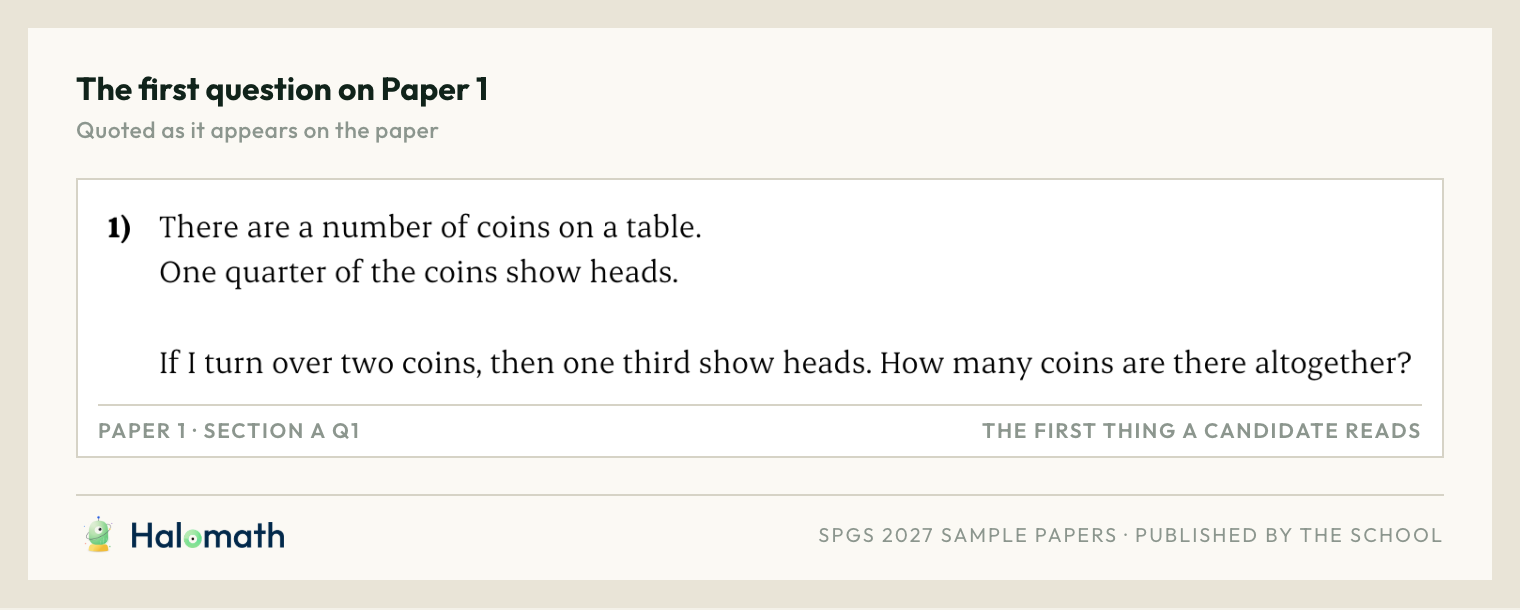
Most selective papers open with something a child can finish quickly, which settles the nerves and gets a mark on the page, and this one does not. To make any progress a ten-year-old has to hold two states of the same pile of coins at once and see that the difference between them is the two she has just turned over. That has to be set up as an equation before any arithmetic can start, and it is the first thing she reads.
I wanted to know whether that opening question was unrepresentative or the shape of the whole thing, so I went through both papers, all 51 questions, and worked out what each one actually asks a child to do. Not one of the 51 questions turned out to be a piece of arithmetic standing on its own, and four other things came out of it as well.
There is no shallow end
Question 1 is already in the hardest band on that paper, and nothing later in either offers somewhere easy to bank a few marks and settle down. That is worth separating from difficulty in general, because every selective paper is hard and saying so tells a parent very little. What is more useful is that they tend to be hard in different ways, and the way is what can be prepared for.
| Paper | What it mostly asks a child to do |
|---|---|
| SPGS 2027 | Reasoning, and little else: no arithmetic anywhere on it, and a quarter of the paper resting on one objective |
| City of London Girls, Stage 2 | Reasoning as well, but a third of it arithmetic, with number patterns — squares and cubes — at the centre |
| Latymer Upper | Reasoning again, almost as much of it, but spread thin rather than concentrated; simple equations and sequences carry most of it |
| Primary Maths Challenge | Shape and measurement alongside the puzzles; the most geometric of the set |
| CSSE | Calculation and estimation, with made-up symbols as a recurring exception — the only other paper here that uses them |
| Sevenoaks | Calculation, and more of it than anything else here |
| ISEB pretest | A little of everything; no single objective takes more than 3% of it |
Set against the other papers I have been through, SPGS stands apart on two things, both of which are about the shape of the working rather than the topic: it asks a child to construct a quantity the question has not given her, and to carry several results at once on the way to an answer. The algebra, the geometry and the arithmetic are all unremarkable for a paper of this kind. Those two habits can be practised directly, whereas simply doing more maths does not practise them.
Nineteen objectives, and two of them do a third of the work
Fifty-one questions sounds like broad coverage, but they land on 19 learning objectives — the particular things a child has to be able to do, at the grain a teacher would write at the top of a lesson, rather than topics such as fractions or area. "Working backwards from a fraction to the original total" is one of the 19, and it has already appeared here: it is the coin question.
Of those 19, seven appear anywhere in the National Curriculum. Counted in questions rather than objectives, 39 of the 51, or 76%, sit outside the National Curriculum mainline. That is not the same as saying the papers are unreasonably hard for the age. It means that most of what is tested here is not what a child meets in an ordinary primary classroom, so it is not a harder version of school maths but a different kind of work.
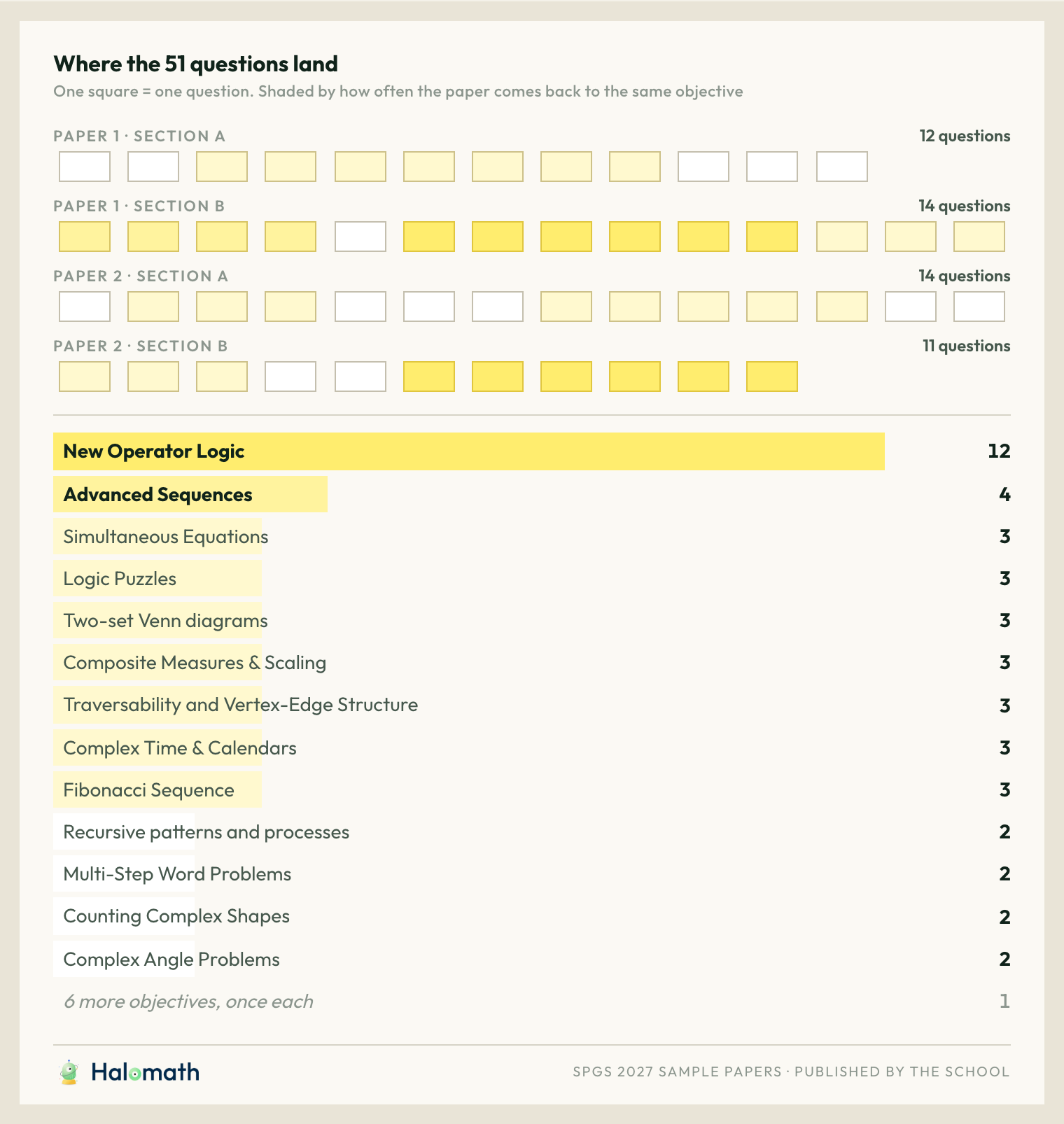
The pattern in that grid is not a paper sweeping the syllabus to see what has been covered. It leans on a handful of objectives and leaves most of the rest alone, which matters if the preparation at home is a revision book organised one topic per chapter. Worked through front to back, a book like that will spend most of a child's time on material these papers never ask about, and reach the objective they lean on hardest somewhere near the end, once or twice.
What the defined-operation questions are doing
A single objective carries a quarter of each paper: 12 of the 51 questions. Each paper invents a symbol, states on the page what it does, and then asks a child to use it, and each gives a whole block of Section B over to it — φ in one, Oₙ, Eₙ and n! in the other.
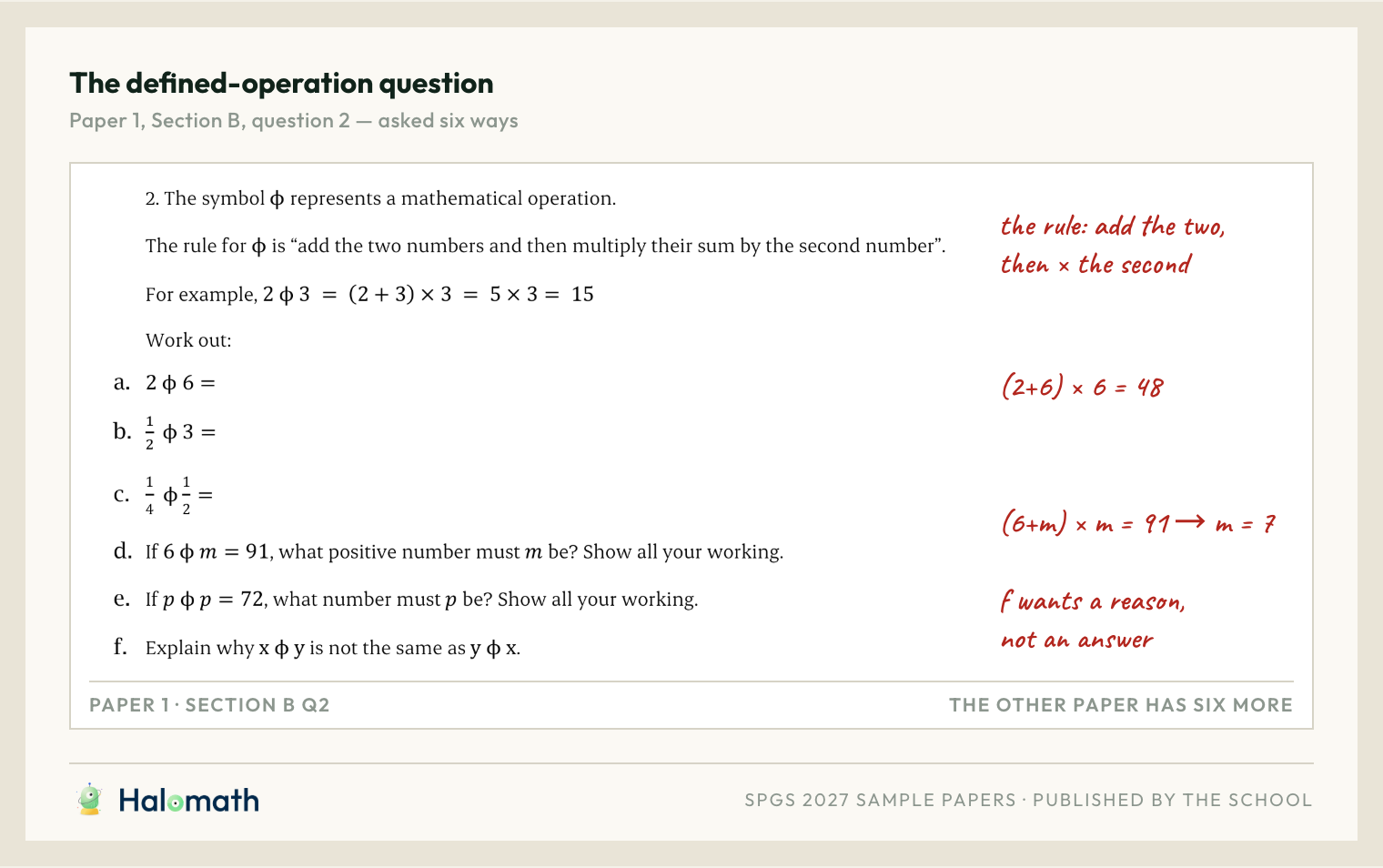
Nothing in it has to be remembered, because the rule is supplied. The asking moves around a good deal — substitute, switch to fractions, run it backwards, and finally explain why the operation is not commutative — but none of those 12 questions requires a child to invent a quantity the question has not given her, and all 12 sit below the median difficulty.
So the block that looks most alarming, a full page of Greek letters and factorials, is in practice the flattest stretch on the paper, and what usually goes wrong there is nerve rather than unfamiliarity with the maths. A candidate meeting a made-up symbol for the first time in an exam hall tends to decide the question is not for her; one who has met a few of them reads the rule and gets on with it. That is worth knowing, because it means the block with the most riding on it is also the one that is most straightforward to prepare.
The difficulty does not sit in a topic
The rest of the material offers no question type to drill, which is where preparation usually goes wrong. What those questions have in common is a way of working rather than a subject: the child has to invent a number the question never gave her, and then run several steps off it.
Two things make a question hard in that particular way — how many separate results have to be worked out before an answer is possible, and whether one of them is a number she had to name herself. Only one question across the two papers is at the far end of both.
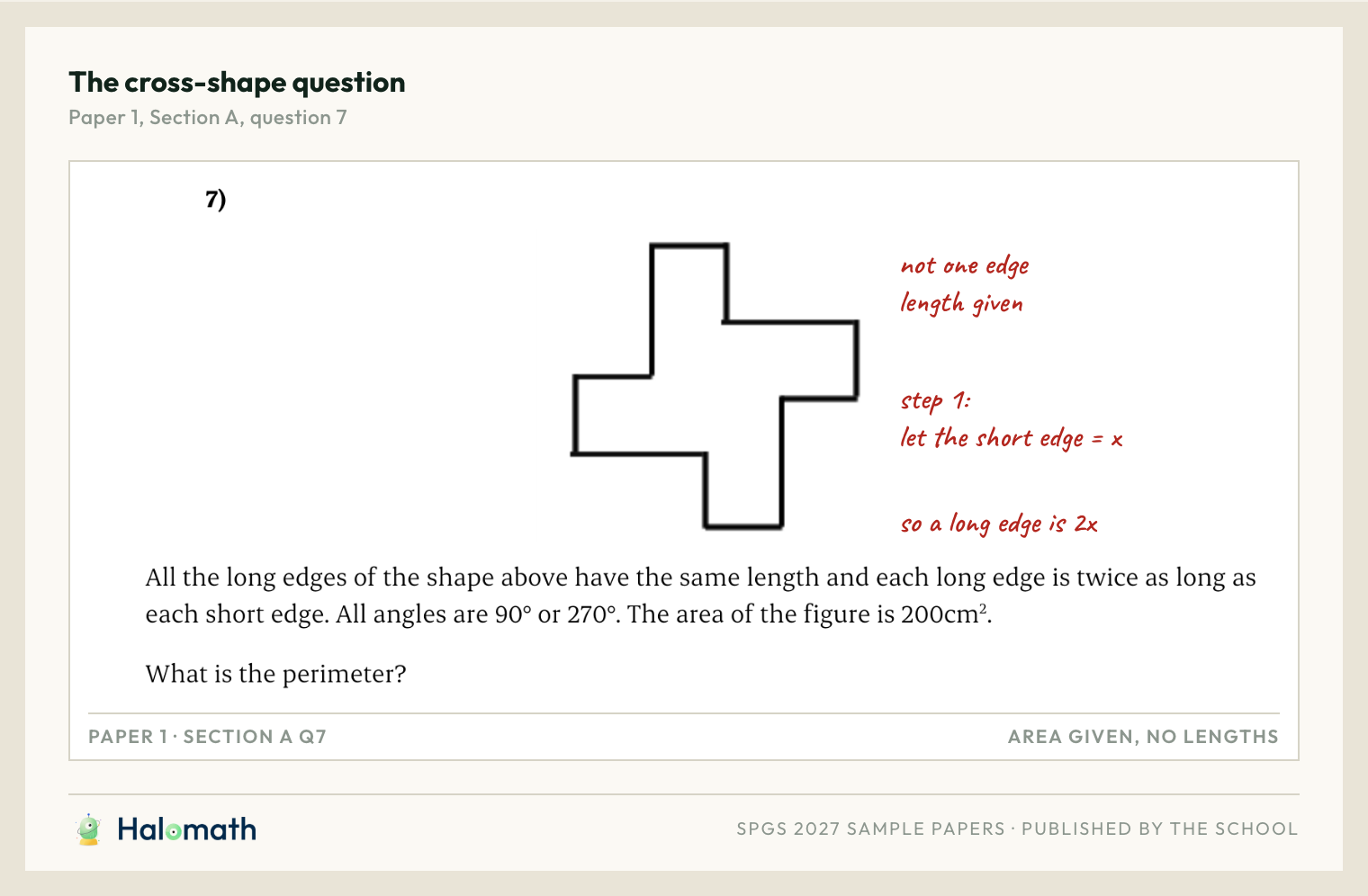
There is an area of 200 cm², one sentence saying that each long edge is twice a short edge, and not a single measurement anywhere on the figure, and the question asks for the perimeter. Before any arithmetic can start she has to decide for herself that the short edge is the thing worth naming, and name it. Nothing on the page asks her to, and that step would be invisible in a mark scheme, although in practice it is the whole question.
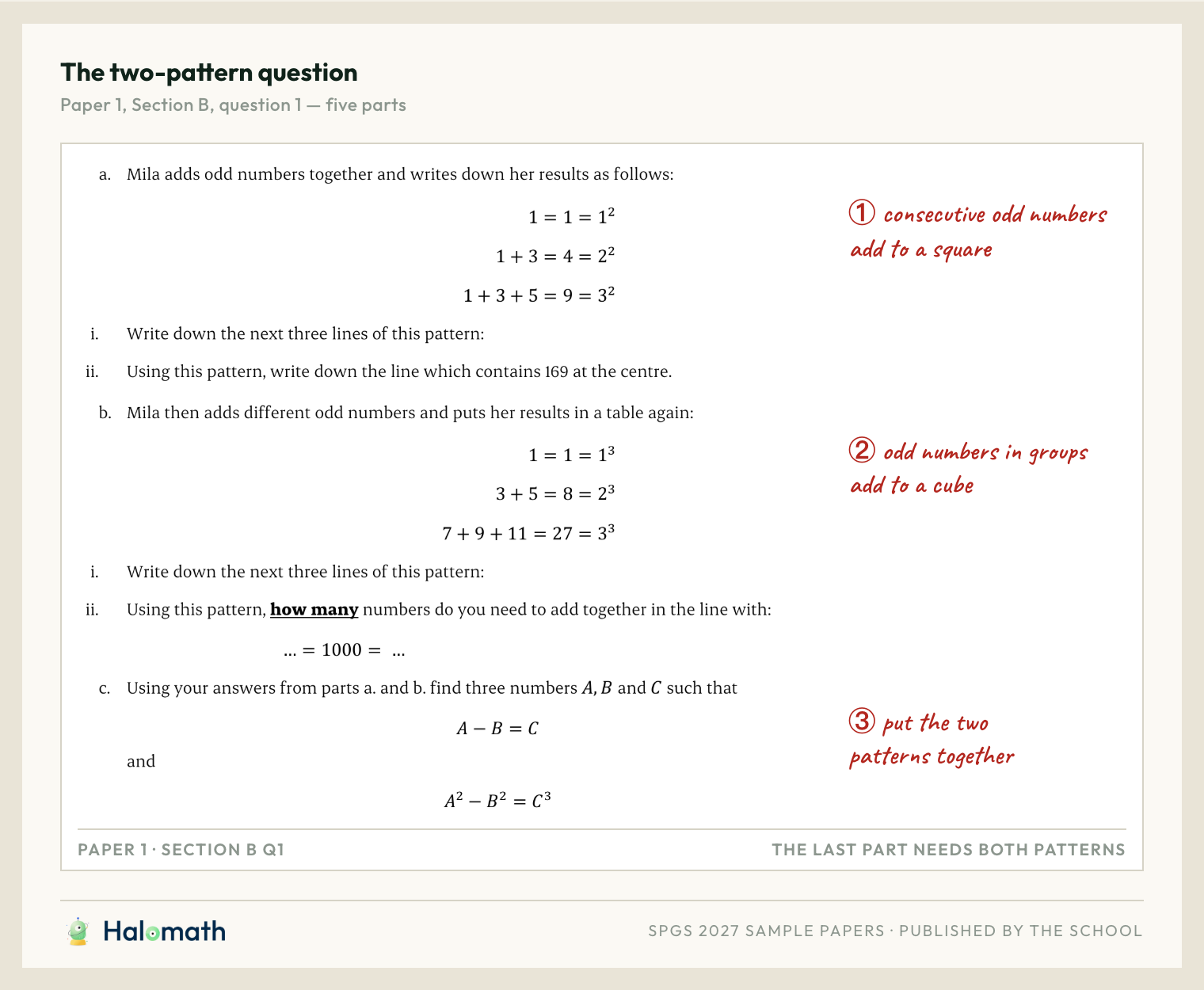
The two hardest questions across the two papers are hard in quite different ways. The first sets out two number patterns, consecutive odd numbers adding to squares and then odd numbers in groups adding to cubes, and its final part says only that the answers to parts a. and b. should be used. A child who has not seen both patterns has no way into it at all, and can be perfectly capable of every individual step while still having nothing to write down.
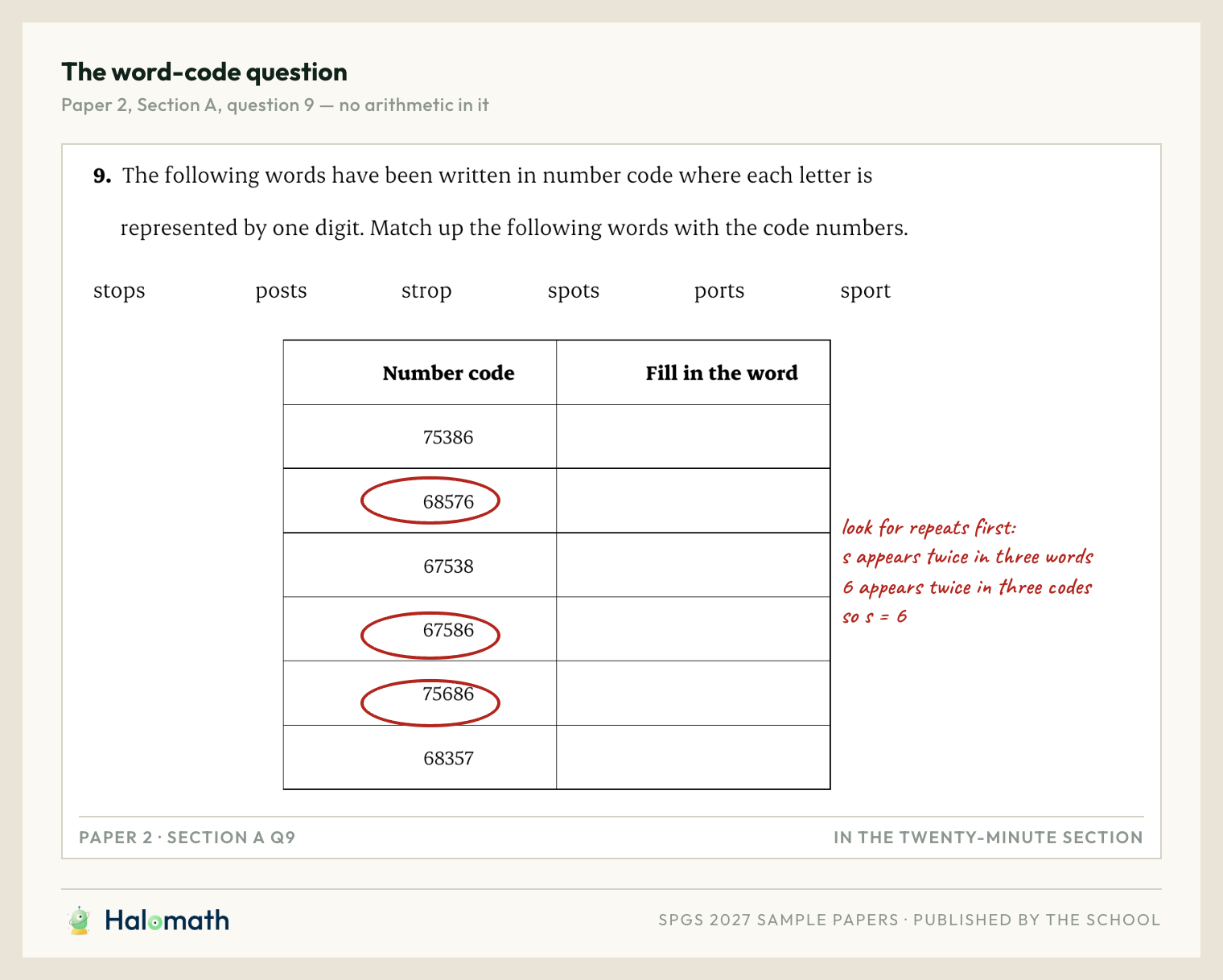
The second is six words written as number codes, to be matched up, and there is no calculation in it anywhere. The way in is to compare where letters repeat, one pair at a time, and eliminate. It sits in Section A, which most children treat as the quicker half, and across the two papers it is the largest single consumer of time.
Taken together, the hardest eight questions sit across six different objectives and fall in both sections, so there is no chapter that can be crammed.
Where this actually starts
Before a child can do anything with 6 φ m = 91 she has to be able to run an equation backwards, which means reading the equals sign as a balance rather than as a signal that the answer comes next. Both of the two largest objectives on these papers stand on that one, and 15 of the 51 questions, 29% of them, sit directly on top of it.
That is not an 11+ topic. It belongs to an ordinary week of ordinary maths, and it is usually settled, one way or the other, long before anyone in the house is thinking about entrance exams. By the time a family begins preparing in earnest the question has often been answered already, without anyone noticing that it was being asked.
This is the reason the thing I build is organised the way it is. Primary maths is held as a map of 232 objectives rather than a list of topics, and 225 of them record what has to be in place before them. When a child comes unstuck, the question worth asking is therefore not which topic she was on, but what that objective stands on and whether that is solid — and the link was written down long before she met the question, so it is a question with an answer.
It is also why the entrance-exam material is not kept in a separate scheme of work. The 11+ objectives sit on the same map as the National Curriculum ones, further along the same chains, so a child doing ten minutes a day years earlier is already on the path this paper sits at the end of, whether or not the words have been said at home.
What I cannot tell you is how children actually do on these papers. Nobody has yet sat them inside the product, so everything above is a reading of the papers rather than a measurement.
What I have built
I am building Halomath, a daily maths coach for UK primary children aged 5–11, and there is a mock of this paper in it. It is not a generic paper with the school's name on the front: the structure follows the real paper section by section, and each question is built to the same objective as the question that sits in that place, with different wording and different numbers each time she sits it. There are not many papers in there yet, and this is one of them.
I have no affiliation with St Paul's Girls' School, and nothing here predicts what will be on any future paper.
If you would like a particular school's paper taken apart this way, tell me which one.